
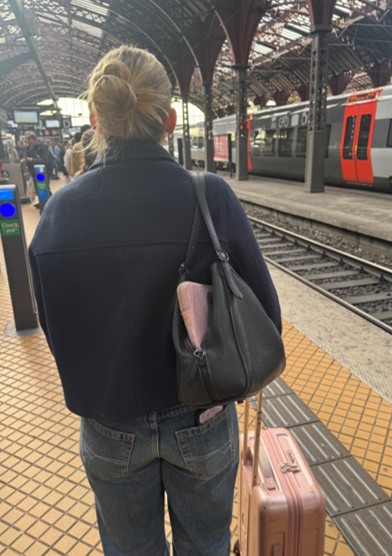
The Joy of Letting Go — and the Ache That Comes With It
He was supposed to be there to help with the move.
To lift the heavy boxes.
To tell her how proud he was.
To drive home with me afterward, both of us quiet in that gentle, aching way that parents are when they’ve just left their child in a new life.
Be part of creating a new dauly routine with just her sister living at home. He should have been part of this new beginning – just as much as me.
Instead, I stood there alone — with one part of my heart walking away into her new beginning, and another part breaking open again.
That’s the strange thing about grief: it doesn’t stay in the past.
It travels with you.
It waits quietly in the background until a new moment of love, pride, or change brings it back into the light.
We often think of grief as something that belongs to funerals, anniversaries, or the dates we dread each year. But so much of grief lives in the everyday milestones — when your child starts school, celebrates a birthday, graduates, or, like now, moves away from home.
Each of these moments carries both joy and sorrow, because each one reminds us of who is missing.
Grief in Disguise
What happens in these moments is a mix of what’s known as “secondary loss” and “transitional grief.”
When someone you love dies, you don’t just lose them once. You lose them again and again, in different forms, across the years.
You lose the future moments they should have been part of — the shared experiences, the simple routines, the everyday “we.”
When your child leaves home, that absence can feel sharper than usual. It’s not only the child you’re letting go of, it’s also the image of the family you once had.
For widowed parents, this transition can be especially layered. There’s the normal ache every parent feels when the house becomes quieter. But there’s also a deeper, quieter grief — the one that whispers: “We were supposed to do this together.”
In my work as a grief coach, I often meet parents who are surprised by the intensity of emotions that surface during milestones like these. They might say:
“I thought I’d be fine.”
“I’m proud of my child, but I just keep crying.”
“It’s not like anyone died again — so why does it hurt this much?”
And that’s the heart of it.
No one died again. But something changed. And every change involves a kind of loss.
The Empty Space at the Table
When my daughter moved out, the most ordinary things became emotional triggers.
Cooking dinner for two instead of three.
Seeing her sister at the other end of the table, a little quieter than usual.
Hearing the silence in the hallway where her laughter used to be.
I would catch myself setting the table for three without thinking. Then pause.
This is called “grief activation”, when new experiences awaken old emotions. It doesn’t mean we’ve gone backward in our grief. It means the love and longing are still there, still part of who we are.
In that sense, love is never “finished.” It just changes shape.
Sometimes I think about how proud Jan would have been. How he would have made jokes to make it light and easy when we left. How he would have carried the boxes two at a time, while pretending it was nothing. How he would have hugged her so tightly before we drove away.
And I let myself imagine it. Because love doesn’t end where life does.
When joy and Grief walk hand in hand
There’s a beautiful paradox in grief that I’ve come to know intimately:
The more we love, the more we grieve.
And the more we grieve, the more we remember that love still exists.
When a child leaves home, every parent feels some version of this. It’s pride and pain all mixed together — the sweetness of watching them grow, and the ache of realizing they don’t need us in the same way anymore.
But for widowed parents, the journey holds an extra layer of complexity. We’re not just letting go of our child’s childhood. We’re letting go alone, on behalf of two people.
And yet, even in that aloneness, there is strength. Because somehow, we keep going. We keep loving. We keep showing up for our children, even when our own hearts are breaking a little too.
What this milestone taught me about grief
As I helped my daughter settle into her new flat, I realized something that has stayed with me:
Grief doesn’t disappear just because time has passed. It transforms.
In the early days after loss, grief is raw and consuming. Like a storm that fills every corner of your life.
Years later, it becomes quieter, more integrated. But it still speaks.
And it often speaks in moments of love, growth, and change.
When we celebrate our children’s milestones, we don’t only see who they are becoming — we see the family we once were, and all that’s missing from the picture.
That awareness doesn’t mean we’re stuck in the past. It means our love still reaches across time.
For me, this milestone has been a reminder of three things:
-
Joy and grief can coexist.
You can be proud and heartbroken at the same time.
You can laugh while your eyes fill with tears. -
Absence is part of love.
The person who’s missing still shapes the way we love, parent, and move forward.
-
Moving on isn’t the goal.
The goal is to move with your grief. To carry it gently, so that it becomes part of your story, not something you fight against.
For parents in transition
If you’re a parent who has lost a partner, and you’re watching your child grow, change, or move away, I want you to know:
You’re not doing it wrong.
That ache you feel, the heaviness, the sudden tears, is not weakness. It’s love, showing you where it still lives.
You can be proud and sad at once. You can celebrate your child and still wish your partner were here to see it. You can smile for the future and ache for the past.
And that’s not a contradiction.
That’s the truth of living after loss.
Every new beginning will hold a trace of what was lost — but it will also hold the strength of what remains.
If you’re navigating a milestone right now
Here are a few gentle ways to support yourself through a transition like this:
 Acknowledge both emotions.
Don’t force yourself to “just be happy.” Give space to the sadness, too. It’s okay to grieve what’s changing.
Talk about the one who’s missing.
Share memories with your child. Tell them what their dad (or mum) would have said or done. It keeps the connection alive.
Create a new ritual.
Light a candle, look through old photos, write a letter, or start a new family tradition that marks this new chapter.
Notice the love that’s still here.
Grief often highlights absence, but if you look closely, you’ll also see the love that continues — between you and your child, in small everyday gestures.
Seek connection.
Talk to others who understand. Whether that’s a friend, a grief group, or a coach — you don’t have to hold it all alone.
A closing reflection
When I hugged my daughter goodbye that day, I whispered, “I’m so proud of you.”
And silently, I added, “Your dad would be too.”
As I drove away, tears blurred the road. But beneath the sadness was gratitude. Gratitude for the love that shaped our family, and for the life that continues through her.
Grief, I’ve learned, isn’t only about endings.
It’s also about beginnings.
Because every time we love again, hope again, or let go again, we carry the ones we’ve lost with us.
And that’s what it means to live after loss — not to leave our love behind, but to bring it with us into whatever comes next.
If you’re a widowed parent trying to navigate change — whether it’s your child leaving home, starting school, or simply growing up faster than you expected — you don’t have to do it alone.
You can download my free guide: 10 Tips for Widowed Parents: How to Support Grieving Children
or join my newsletter for more reflections, tools, and gentle guidance for your grief journey.
Click here to download and sign up for my newsletter here.
Because even when life changes, love remains.