
If you’ve found this page because your husband died recently, I want you to know something before you read another word: you don’t have to take any of this in right now. Read a little, close the tab, come back when you’re ready. This page will still be here.
My husband died. Why does life suddenly feel impossible?
If you’re here, something unthinkable has happened. Your husband died, and the world you knew ended with him.
Maybe it happened days ago. Maybe weeks. Maybe you typed “my husband died now what” into Google at 3am because you couldn’t sleep and didn’t know who else to ask. However you got here, I’m glad you did — because I’ve been exactly where you are.
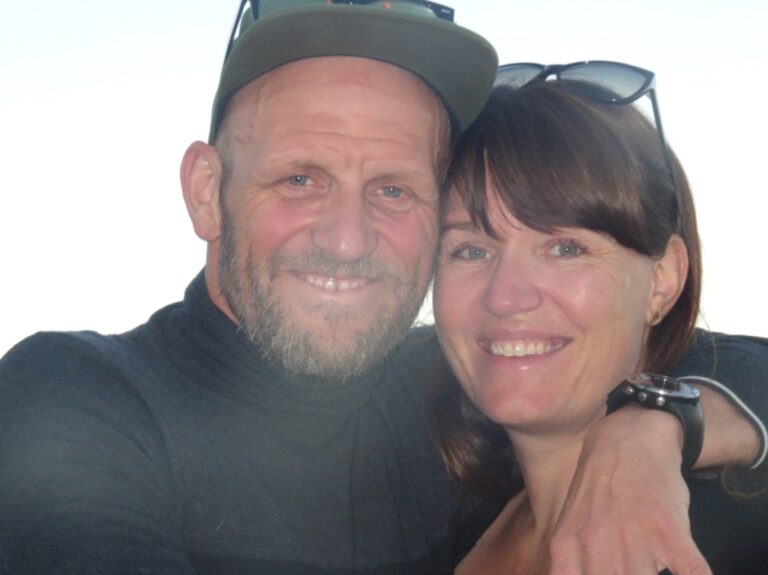
My husband Jan died after living with MND, and I remember looking at my daughters the next morning and thinking, they still need breakfast… and I don’t know how I’m supposed to do this. They still needed lifts to school, clean clothes and someone to remind them to brush their teeth. The world had stopped for me, but it hadn’t stopped for them.
The death of a husband isn’t just the loss of a person. It’s the loss of your daily rhythm, your future plans, the hand you reached for, the person who knew how you take your coffee. That’s why life feels impossible right now, because in a very real sense, the life you had is gone, and the new one hasn’t formed yet.
You are not going mad. You are grieving. And grief this raw is supposed to feel like this.
I’m a grief coach with a master’s degree in psychology, and a widowed mum of two. Everything in this guide comes from both sides of that experience – the professional and the deeply personal.
If you’re wondering “Now what?” – you’re asking the wrong question
I understand why you’re asking it. “Now what?” is the question our brains reach for when everything collapses. We want a plan, a checklist, a way through.
But here’s the gentle truth:
There isn’t one thing you should do next
There is no correct sequence for surviving the loss of a husband. No official timeline. No grief manual that everyone else received and you somehow missed.
If you’ve been lying on the sofa for three days, that’s grief. If you’ve been frantically cleaning and organising, that’s grief too. If you laughed at something yesterday and then felt guilty about it — that’s also grief.
There is no right way to do this. So if part of your panic is the feeling that you’re doing it wrong — you can put that down. You’re not.
Your only job right now is to get through today
Not the next five years. Not the finances, the house, the future. Just today.
In the early weeks after losing a husband, survival mode is not a failure — it’s your mind protecting you. So make the bar low:
- Drink some water
- Eat something, even if it’s toast
- Get some rest, even if proper sleep won’t come
- Let one person help you with one thing
If your children are fed, hugged and make it to school in matching shoes most days, you’re doing enough. It may not feel like enough, but it is.
Truly. One day, one hour, sometimes one breath at a time.
What grief after losing your husband can really feel like
One of the loneliest parts of early grief is thinking your reactions are abnormal. They almost certainly aren’t. Here’s what grieving after losing your husband can actually look like.
Emotional symptoms
Guilt. “I should have noticed.” “I should have said more.” Guilt is one of the most common — and most unfair — companions of widow grief, especially after a sudden death.
Anger. At him for leaving. At doctors. At friends whose husbands are still alive. At the universe. Anger is grief wearing armour.
Emptiness. Some days you may feel nothing at all — flat, numb, hollow. Numbness isn’t a lack of love. It’s your mind rationing pain.
Anxiety. Many widows describe a new, constant hum of fear: What else could happen? What if something happens to the children? How will we cope? When the worst has already happened once, your nervous system stops believing you’re safe.
Longing. “I miss my husband so much” and “I want him back” aren’t just thoughts — they can feel like a physical ache. Yearning for him is not a sign you’re stuck. It’s a sign you loved him.
Physical symptoms
Grief doesn’t stay in your heart. It moves into your body:
Sleep problems — lying awake, or sleeping constantly and never feeling rested
Bone-deep exhaustion, even after doing “nothing”
Brain fog — forgetting words, losing your keys, reading the same sentence five times
Tightness in your chest or a heavy, physical weight
Appetite changes — no interest in food, or eating on autopilot
You may forget school emails, miss appointments or suddenly realise you’ve been staring into the fridge without knowing why. It isn’t because you’re failing. Your brain is working incredibly hard to process trauma.
Why grief comes in waves
Perhaps you’ve noticed this already: you manage a whole morning, even a whole day — and then a song, a smell, or his handwriting on a shopping list knocks you flat. Sometimes it’s not the big anniversaries that break you. Sometimes it’s seeing another dad collecting his children from school. Or hearing your child say, “Daddy would have loved this.”
Grief isn’t a slope you steadily climb. It comes in waves. Some are gentle. Some arrive out of nowhere and pull your legs from under you. This unpredictability is one of the hardest things about the death of a spouse, because you can never quite brace for it.
But the waves are not evidence that you’re going backwards. Over time, most people find the waves come slightly less often and last slightly less long. The sea never fully stills, but you slowly learn to swim in it.
If your husband died suddenly and unexpectedly, the waves may be higher and more chaotic for longer. Losing a spouse unexpectedly means your mind never got to prepare — so it keeps trying to catch up, replaying moments, searching for warning signs. That’s not obsession. That’s your brain trying to make sense of the senseless.
If you’d like to understand why grief feels so unpredictable, I’ve written more about grief stages and waves here.
If you have children, your grief becomes even more complicated
The hardest part wasn’t losing my husband. It was waking up the next morning and realising my daughters still needed breakfast.
For widowed mums, there’s a layer of loss that childless grief guides simply don’t cover: you’re not just grieving. You’re parenting through grief.
You’ve lost your husband, and your children have lost their dad. Two enormous griefs living under one roof, and somehow you’re expected to hold both.
Many widowed mothers tell me the same thing: “I don’t have time to grieve. I have to keep things going for the kids.” And I understand it, because I lived it. But grief doesn’t queue politely for a convenient moment. It leaks out – in irritability, exhaustion, tears in the bathroom with the tap running.
You don’t have to be a perfect parent right now. You have to be a present one. Those are very different things.
Your children don’t need you to hide your grief
This might be the most important thing on this page.
So many mums believe they must be strong and never cry in front of the children. But when we hide all our grief, our children learn a quiet, damaging lesson: sadness is something to hide. And then they hide theirs — from us.
Children don’t need a mum who never cries. They need a mum who shows them that big feelings can be felt, expressed and survived. When you say, “I’m crying because I miss Daddy. It’s okay to miss him,” you give your child permission to grieve too.
This is the heart of what I call the Mirror Method: express first, then expect. When you gently show your own feelings first, your child feels safe enough to show theirs. Children mirror what they see — not what they’re told. Long before I called it the Mirror Method, I watched it happen with my own daughters.
(I’ve written more about this in How to support a child after the death of a parent — a gentle, practical guide for exactly this.)
Small conversations matter more than perfect words
You don’t need a big, formal “talk about Daddy”. Those tend to make children clam up anyway.
What helps far more is small, everyday moments:
- “Daddy would have laughed at that.”
- “I thought about Dad today when I saw a red car like his.”
- “Do you ever miss him at bedtime? I do.”
Little doors, opened gently, again and again. Some days your child will walk through them; other days they won’t — and both are fine.
And if your child has gone quiet about their dad entirely, that’s more common than you’d think. I’ve written about why in [Why Your Grieving Child Won’t Talk].
Things you don’t need to figure out today
After the death of a husband, well-meaning people arrive with questions dressed up as advice. When are you sorting his things? Will you stay in the house? You’re still young — will you meet someone eventually?
Here is your permission slip to answer none of it. If you’re wondering what to do when your husband dies — in the UK there are certainly practical steps like registering the death and dealing with probate, and it’s fine to ask for help with those — but the big life questions can wait.
His belongings
There is no deadline. His coat can hang by the door for as long as it comforts you. Some widows sort things within weeks; others take years; many keep certain items forever. His jumper in your wardrobe is not a sign you’re “not moving on”. It’s love, in fabric form.
My girls weren’t ready when I was. Later, there were things I wasn’t ready for that they desperately wanted to keep. We discovered that grieving rarely happens on the same timetable.
Moving house
Grief experts often suggest avoiding major, irreversible decisions in the first year if you possibly can. Your judgement is running on an exhausted, grieving brain — and the house that feels unbearable at month two may feel like a sanctuary at month ten. If you can wait, wait.
Dating
If the thought makes you feel sick — fine. If, one distant day, the thought sparks something — also fine. There is no schedule, and nobody else gets a vote. Right now, this question doesn’t even need to be on your list.
If you’d like to read more about widow dating, I’ve written more about it here.
Big life decisions
Careers, savings, relocating, selling the car. Unless something is genuinely urgent, park it. Write it on a list titled “Not yet” and give yourself the gift of deciding later, when your mind has a little more room.
What actually helps after your husband dies
There is no fix for grief — but there are things that genuinely make the unbearable slightly more bearable. Here’s what helped me, and what helps the widowed mums I work with.
Accept practical help
When someone says “let me know if you need anything”, most of us say “thanks, I’m fine” on autopilot. Try, instead, to give people a job:
“Could you do a food shop on Thursday?”
“Could you pick up my kids from school on Thursday?”
“Could you sit with me while I open the post?”
People want to help. They just don’t know how. Specific requests are a kindness to them and a lifeline for you.
Find people who truly understand widowhood
Friends and family love you, but unless they’ve lost a spouse, there’s a room they can’t enter. Other widows can. Whether it’s a local group, an online community, or one widowed friend-of-a-friend — finding even one person who says “yes, me too” can be extraordinarily comforting after the loss of a husband.
Stop expecting yourself to be “back to normal”
I spent months waiting to feel like myself again. Eventually I realised she wasn’t coming back. There is no “back”. The old normal included him. What lies ahead isn’t a return — it’s a slow building of something new, and that takes far longer than our culture (or your inbox, or your employer) tends to allow. If you feel worse at month four than you did at month one, you’re not failing. You’re feeling — because the numbness has thawed.
Give yourself permission to rest
Grief is exhausting on a physical level. Your body is doing enormous invisible work. So rest is not laziness; it’s part of grieving. Say no to things. Cancel plans. Lower the housework standards. Let the children watch a bit more telly than usual. None of this makes you a bad mum. It makes you a human one.
What nobody tells you about widowhood
There are things about losing a husband that I only learned by living them — and that I now tell every widow I work with, because nobody told me.
Grief changes shape. It doesn’t disappear. The idea that you “get over” a husband’s death is a myth. Instead, grief softens, shifts and weaves itself into your life. You don’t get over him. You grow around the loss.
Some people will disappear. This one stings. Friends you counted on may go quiet — not because you did anything wrong, but because your loss frightens them or they “don’t know what to say”. And, unexpectedly, other people will step forward. Let the leavers leave and the stayers stay.
Your identity changes. You weren’t just married to him — part of who you were existed with him. Wife, partner, half of “us”. Losing a husband means slowly, painfully rediscovering who you are on your own. It’s disorienting. In time, it can also hold quiet, surprising strength.
Your children grieve differently to you. One day your child may cry because they miss Dad. The next day they’ll laugh with their friends as if nothing has happened. Then you’ll wonder if they’re grieving “properly”. They are. Children step in and out of grief in a way that adults often don’t. They also often re-grieve at each new stage of life, understanding the loss anew as they grow.
Healing isn’t forgetting. Somewhere along the way, you may fear that feeling better means leaving him behind. It doesn’t. Laughing again, living again, even loving life again — none of it erases him. He stays woven into you and your children. Healing simply means the love starts to outweigh the pain.
You don’t have to do this alone
If you take just three things from this page, let them be these:
- There is no right way to grieve, and you are not doing it wrong.
- Your only job right now is today – the big decisions can wait.
- Your children don’t need a perfect mum. They need a real one, who shows them that grief can be felt and survived.
I can’t take away the fact that your husband died. I wish I could. But you will not always feel the way you feel today. I promise you that. And I can tell you this: your children do not need you to have all the answers. They need you. One ordinary day at a time.
If you’d like a hand with the part so many of us find hardest — helping your children grieve while you’re grieving yourself — I’ve made a free guide with gentle, practical ways to start those conversations. You can download the free guide here.
And if you’d rather talk to someone who truly gets it, you’re warmly invited to book a free Clarity Call with me. No pressure, no obligation — just a calm conversation about where you are and what might help.
One day at a time. You’re doing better than you think.
Frequently asked questions
Yes – completely normal. Your husband was woven into every part of your daily life, so his death unravels far more than most people realise: your routines, your plans, your sense of safety, even your sense of who you are. Feeling lost isn’t a sign something is wrong with you. It’s a sign of how much he mattered.
There’s no fixed timeline, and anyone who gives you one is guessing. For most widows, the sharpest, most disorienting grief slowly softens over the first one to two years – but grief doesn’t end so much as change shape. You’ll likely carry some form of it, gently, for life, alongside more and more room for living.
This surprises many widows, but it’s very common. In the first weeks, shock and numbness cushion you, and practical tasks and visitors keep you occupied. Around three to six months, the shock fades, the world moves on, and the full reality lands. Feeling worse later isn’t a setback. It’s often the moment real grieving begins.
No – and this matters enormously. When children never see our grief, they learn that sadness must be hidden, and they start hiding theirs from us. What helps is showing your feelings in a calm, contained way: “I’m crying because I miss Daddy, and that’s okay.” You express first, and then your child feels safe enough to express too.
Keep it small and steady. Maintain simple routines, mention their dad naturally in everyday moments, answer their questions honestly in age-appropriate words, and let them see that feelings are allowed in your home. You don’t need perfect words – you need small, repeated openings. My guide on how to support a child after the death of a parent walks you through this step by step.
Whenever you’re ready – and not a day before. There is no deadline, no etiquette, no point at which it becomes “unhealthy” to still have his things. Some widows sort belongings within months; others take years; most keep certain treasures forever. Ignore anyone who pressures you. His things are yours to keep, share or release in your own time.
Yes. Desperately wanting him back – talking to him, aching for one more ordinary evening together – is one of the most universal parts of widow grief. Yearning isn’t denial and it isn’t madness. It’s love with nowhere to go. Over time, that love finds new places to live: in memories, in your children, in the way you carry him forward.
It really can. Grief is a whole-body experience: exhaustion, chest tightness, headaches, a weakened immune system, appetite and sleep changes, and the famous “widow’s brain fog” are all common. Be gentle with your body. It’s working hard. That said, if physical symptoms are severe or persistent, do see your GP; you deserve care, and some things should be checked.