The 5 or 7 stages of grief
You might have heard about the stages of grief, and since you’ve opened this blog post, you’re probably looking to better understand what these stages involve. Perhaps you feel you are somewhere in your grief journey that more or less aligns with one of these stages. Or maybe you feel like you don’t recognize yourself in them at all.
If you’re grieving, you’re likely reading or hearing about grief stages from friends and family who wish to support you. Here, I’ll outline the commonly discussed five stages of grief (some even mention seven stages), to help you understand them better. However, I will also explain why it’s actually incorrect to speak of grief as stages if you’ve experienced a loss. So, if you don’t see yourself or your journey in the five stages of grief, that’s completely normal!
Who created the five stages of grief?
The five stages of grief were formulated by a Swiss-American psychiatrist named Elisabeth Kübler-Ross. She discovered that individuals diagnosed with terminal illness often went through five stages: Denial, Anger, Bargaining, Depression, and Acceptance.
You might still encounter a nurse, funeral director, or others mentioning these grief stages, but this is actually a misunderstanding. The five stages were developed specifically for people facing their own death due to illness.
When my husband Jan received his ALS diagnosis, he was also given a death sentence, as ALS has no hope for recovery.
To a certain extent, Jan did go through these five stages.
Initially, he experienced denial – he couldn’t believe he was actually dying, especially as he still felt healthy and active.
His anger manifested mostly as frustration over the complete absence of any cure or even effective treatment to prolong or alleviate his condition.
The bargaining period was brief since there was essentially nothing to negotiate – no one could explain why he, in particular, had been struck by ALS. There was nothing he could have done differently.
But he was depressed for a longer period of time and required antidepressants to maintain emotional stability. He used all his energy to keep busy, preventing him from dwelling too much on the sorrowful thought of leaving our daughters and me behind.
Once he accepted that death was inevitable, a calm settled over him. Though antidepressants accompanied him until the end, he increasingly managed to live in the present and create good memories with friends, our daughters, and me.
At night, just before his sleeping pills kicked in, he’d fold his hands behind his head, sigh contentedly, and say, “We’re actually doing pretty well. I might be dying, but we’re okay.”
Can’t relate to the five stages of grief in your own journey?
Even though the stages of grief were intended for terminally ill patients, they are often incorrectly applied to everyone experiencing grief. We’re frequently told grief must be processed through specific stages – as if we must pass through a set sequence of emotions and stages. You might even hear people say, “You’re probably still in the denial stage,” or ask, “Which stage of grief are you currently in?”
Maybe this confuses you because you don’t feel your grief fits into these neat stages. You might not see yourself in these five fixed stages at all.
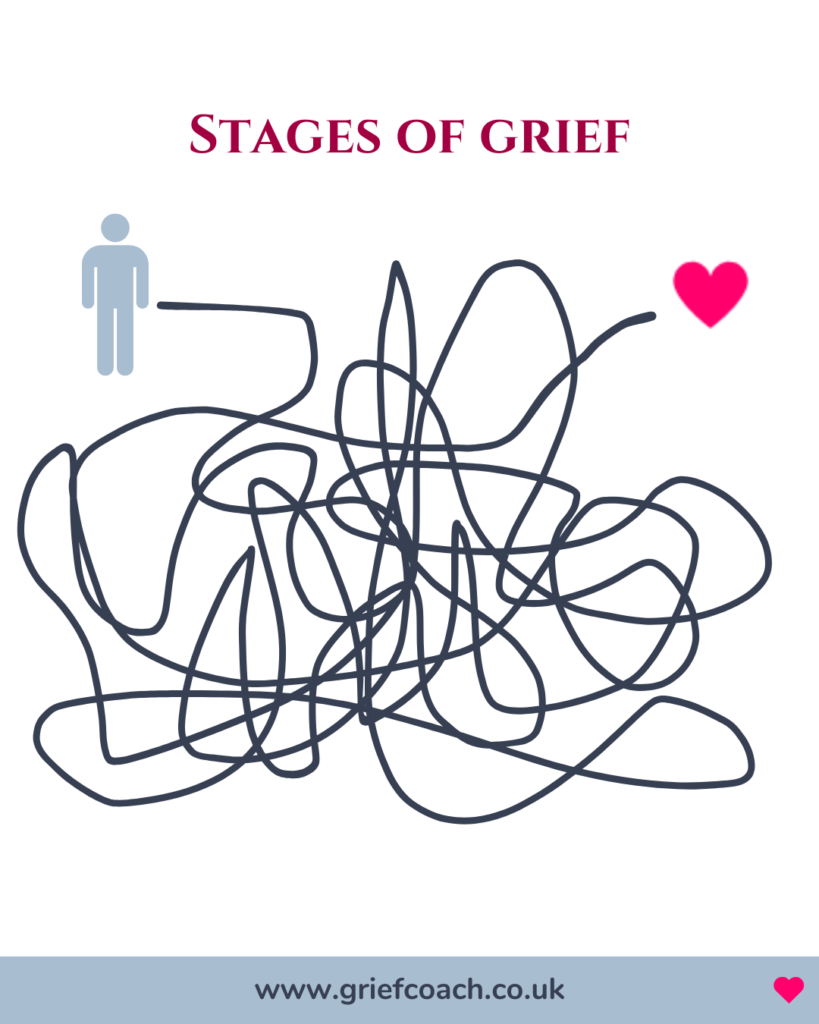
It’s entirely normal not to feel aligned with the stages of grief – because, in reality, there are no fixed stages in grief. Today, grief is described more accurately as coming in waves. Sometimes the waves are powerful and overwhelming, other times gentle and manageable. It’s a misconception that grief involves clearly defined stages that follow each other in order. That suggests you must go through a specific path that all grieving people supposedly follow. You don’t!
Grief isn’t a linear process we move through, like walking down a straight path.
Grief is messy. Grief is chaotic.
Every grief is unique
All of us who experience grief—due to losing someone close, caring for a critically ill partner, or grieving for other reasons—cannot neatly categorize our grief into stages. For us, grief is deeply personal. Our grief differs significantly from that of someone who knows they will die because we must continue living. We have to find a way to live our lives, navigate our unique grief journeys, and find hope amid feelings of hopelessness. Even our grief differs from one another’s. We can find recognition and comfort in the experiences of others, and we can seek and receive support. But no two people experience grief in exactly the same way or process it through the exact same sequence of emotions.
For some, believing in five stages of grief might feel comforting. These stages can act as a roadmap or lifeline when the familiar world collapses. But what happens if your grief doesn’t match these stages? If you never become angry or haven’t experienced denial? You might mistakenly think your grief is “wrong,” that you’re not processing your loss correctly since you aren’t following these supposed stages.
So, remind yourself there are no fixed stages you must pass through. Your grief is unique, meaning your path through it will also be unique and personal.
If you feel ready for grief counseling and therapy, you can read more about my sessions here.
My goal is to support you in your grief, no matter where you are on your journey. To help you return to a life where joy outweighs sorrow. In my sessions, you’ll find understanding and compassion. You’ll experience my genuine presence and willingness to generously share my personal story and insights. And you’ll discover there’s always room for laughter and fond remembrance.
You’re always welcome to contact me to learn more about how I can support you.